

Bambu Lab H3C Filament Drying: Are Two Drying Slots Enough?
The Bambu Lab H3C brings a new approach to multi-material 3D printing. With nine independent print tools and an integrated AMS 3H filament management system, users can manage multiple spools and switch between materials automatically.
However, although the AMS 3H can hold nine spools, only two dedicated positions support active drying. For users who mainly print PLA, this may be enough. But if you regularly work with PETG, TPU, or other moisture-sensitive materials, are two drying slots sufficient?
1. How Does Filament Drying Work in the AMS 3H?
According to Bambu Lab, the AMS 3H offers several filament management features:
- Storage for up to nine filament spools.
- Two dedicated active drying slots.
- Maximum drying temperature of 85°C.
- Active drying while printing.
- Integrated automatic filament feeding.
One important distinction: nine-spool storage does not mean nine spools can be dried simultaneously. Only two positions support active drying, while the remaining positions are designed for enclosed filament storage.
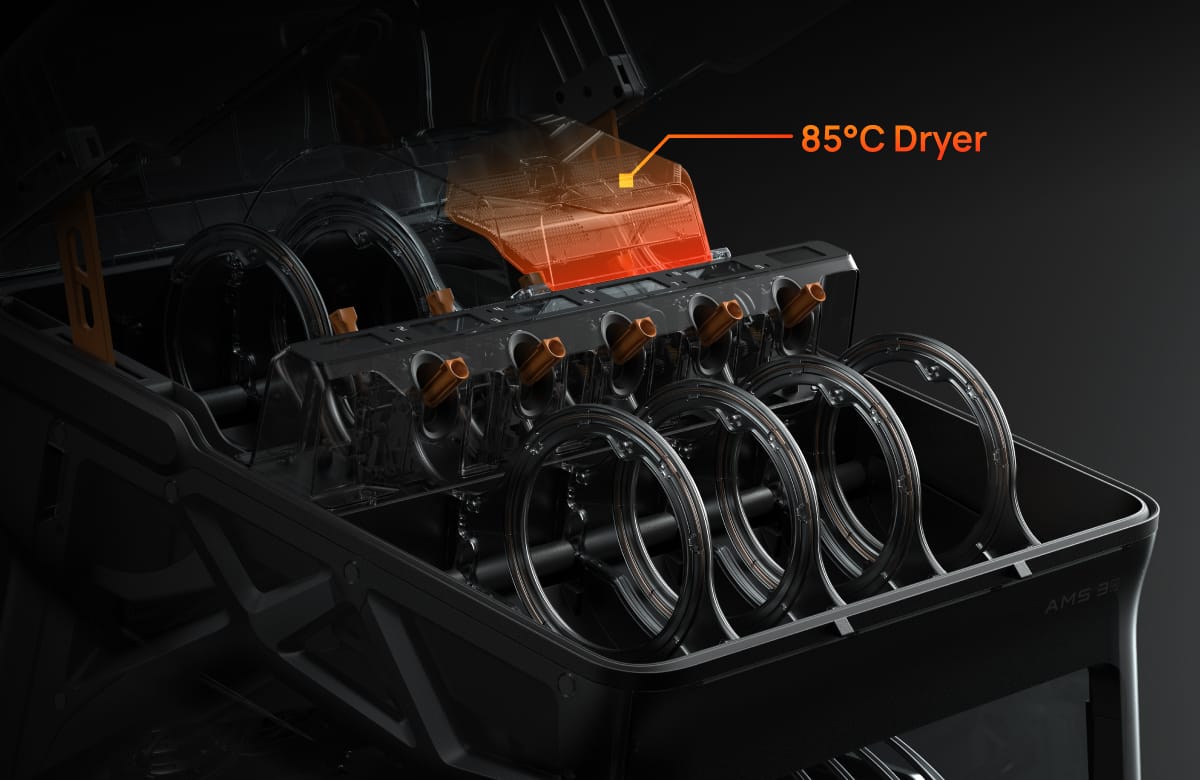
Official announcement: Bambu Lab H3C
2. Why Does Filament Need Drying?
3D printing filaments absorb moisture from the surrounding environment. When wet filament passes through a heated nozzle, absorbed moisture can vaporize, potentially causing bubbling, inconsistent extrusion, stringing, and surface defects.
A 2023 study published in Polymers investigated the moisture absorption behavior of 12 FFF filament types under different relative humidity conditions, ranging from 16% to 97% RH.
Moisture Absorption Capacity of Different Filament Samples
| Filament Sample | Material | Δw∞ (%) |
|---|---|---|
| ABS White | ABS | 0.157 |
| PET-G | PETG | 0.696 |
| PLA Cnd | Conductive PLA | 0.800 |
| PLA LAVA | Color-changing PLA | 0.724 |
| PLA T-W | Tough PLA | 0.706 |
Source: Aniskevich et al., 2023, Polymers, Table 2. Δw∞ represents the equilibrium moisture uptake reported in the study. These values are specific to the tested commercial filament samples, not universal moisture absorption rates for each material.
The results show that moisture absorption varies between filament types and formulations. Even filaments within the same material family can behave differently depending on their composition and additives.
For more details, see the original research: Moisture Sorption and Degradation of Polymer Filaments Used in 3D Printing.
3. Are Two Drying Slots Enough?
For users who mainly print PLA and occasionally use PETG, the two active drying slots in the AMS 3H should be sufficient for most everyday needs.
However, if you regularly switch between different materials or prepare several spools before a print job, two slots may become a bottleneck.
For example, if a project requires four different spools and all of them need drying beforehand, the AMS 3H can only process two at a time. An additional multi-spool dryer can make filament preparation more efficient.
4. Chitu Systems E1: An Additional Four-Spool Drying Solution

The Chitu Systems FilaPartner E1 features two independently controlled drying chambers. Each chamber holds two standard 1kg filament spools, allowing up to four spools to be dried simultaneously.

Two Independent Temperature Chambers
The E1 operates within a temperature range of 45–70°C. Each chamber has independent temperature control, allowing users to select different settings or operate only one chamber when needed.
| Material | Temperature | Drying Time |
|---|---|---|
| PLA / PLA+ | 50°C | 6h |
| PETG | 60°C | 6h |
| TPU | 60°C | 12h |
| ABS / ASA | 65°C | 8h |
These are Chitu Systems' recommended reference settings. Actual drying requirements may vary by filament brand and formulation. Always follow the filament manufacturer's instructions.
Removable Chambers for Convenient Storage
After drying, the E1's chambers can be detached from the heating base and used as separate filament storage boxes. Each box includes a humidity indicator, reusable desiccant, and a magnetic sealing structure to help protect filament from ambient moisture.

For H3C users, the E1 can serve as a separate filament preparation station. Dry compatible spools in the E1, then transfer them into the AMS 3H for automatic feeding. The E1 does not directly integrate with the H3C's automatic feeding system; its purpose is to provide additional drying and storage capacity.
Explore Chitu Systems FilaPartner E1 →
5. Final Verdict: Do You Need an Additional Filament Dryer?
For everyday PLA and PETG printing, the two active drying slots in the AMS 3H should be sufficient for most users.
However, if you regularly prepare multiple PLA, PETG, or TPU spools, additional drying capacity can make your workflow more flexible and reduce preparation time.
With four-spool capacity, two independent temperature chambers, and removable storage boxes, the Chitu Systems FilaPartner E1 offers an additional drying solution for H3C users who frequently prepare multiple spools of everyday filaments.
Frequently Asked Questions
Can the Bambu Lab H3C dry filament while printing?
Yes. The AMS 3H supports active drying while printing.
Do all nine AMS 3H slots support active drying?
No. Only two dedicated slots support active drying. The remaining positions provide enclosed filament storage.
Can I use an external filament dryer with the H3C?
Yes. You can dry compatible filament separately and transfer it into the AMS 3H. External dryers do not directly integrate with the H3C feeding system.
How many spools can the Chitu E1 dry at once?
The E1 can dry up to four standard 1kg spools using its two independently controlled chambers.
References
- Aniskevich et al. (2023). Moisture Sorption and Degradation of Polymer Filaments Used in 3D Printing. Polymers, 15(12), 2600. DOI.
- Bambu Lab. H3C Official Announcement.
- Chitu Systems. FilaPartner E1 Product Specifications.